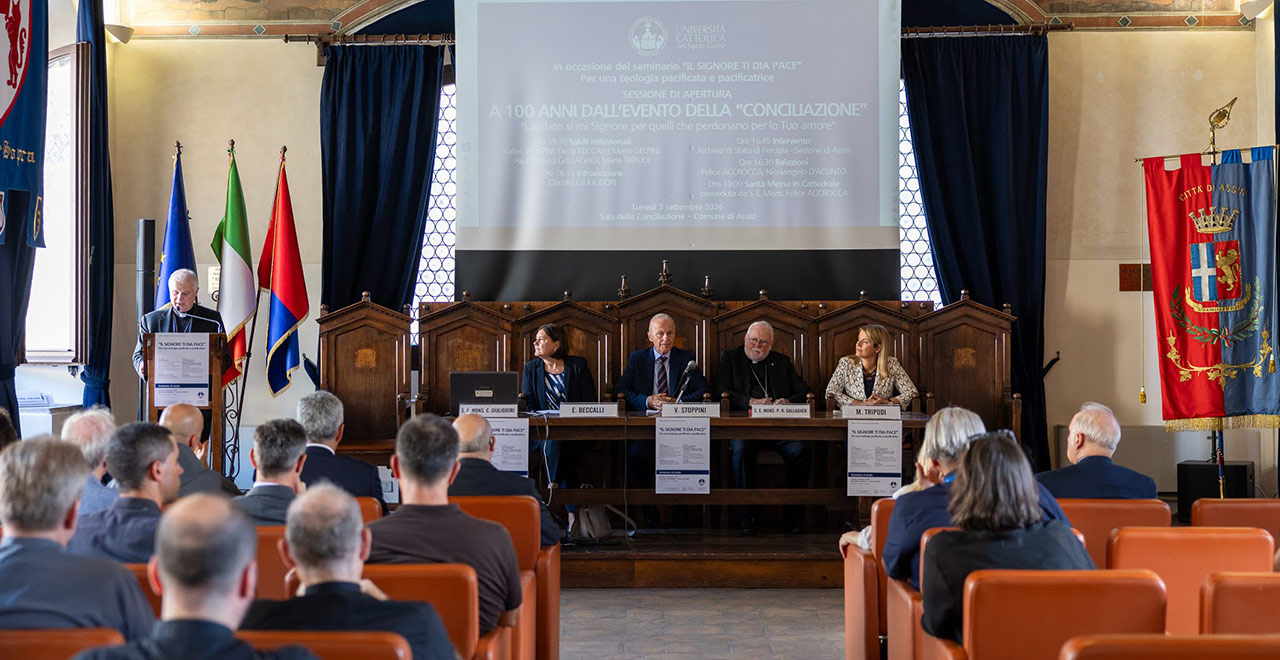
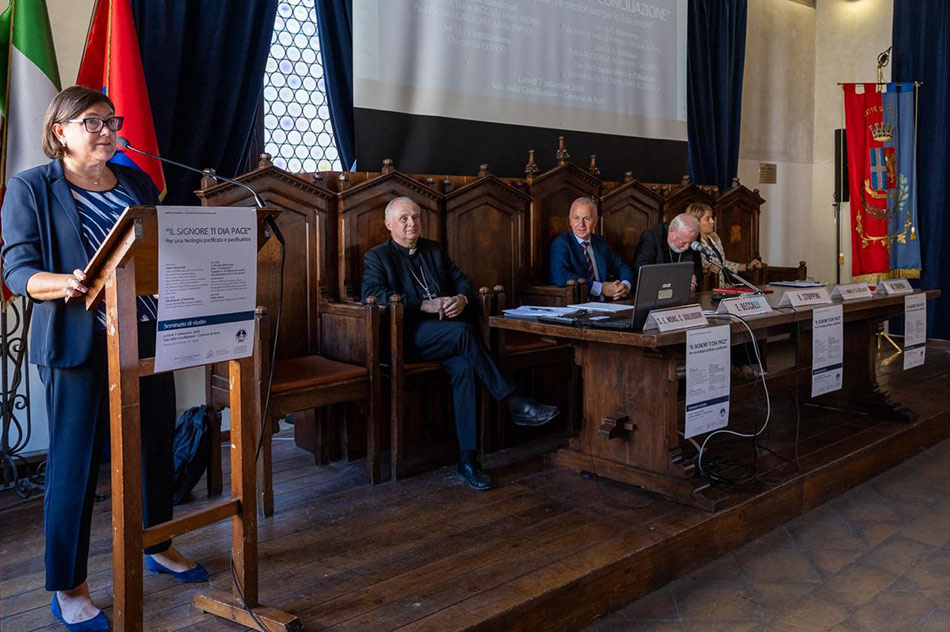
“Speaking of peace here in Assisi cannot be a mere ritual: true reconciliation is neither a signature nor a superficial compromise. Instead, it requires the courage to forgive – understood as a conscious choice not to remain hostages to historical wounds – so that we may build paths of peace together,” said the Mayor of Assisi, Valter Stoppini, as he commenced the proceedings. “At a time when the world seems to have lost the language of dialogue and of the encounter, preferring polarisation, suspicion and physical strength, the city of St Francis must not be a mere backdrop, but an ongoing building site, a space where listening comes before judgement and where the coming together of institutions, research and faith is transformed into concrete hope for society.”
Returning to the historical significance of 4 October 1926, the Rector of Università Cattolica del Sacro Cuore, Elena Beccalli, highlighted the spirit of an authentic “culture of negotiation”, which remains essential even today, as Pope Leo XIV reminds us in Magnifica humanitas, to build a “civilisation of love”. The Rector then emphasised the “foundational value of the dialogue between theology and the various disciplines”, the role of universities as “institutions of peace”, “arenas for interreligious and geopolitical dialogue” at the service of national and international communities, and “bridges between civilisations to build stable and fruitful relationships”. She then recalled how Francis’s example can still be a source of inspiration, announcing that in a few weeks’ time the University, in collaboration with the publishing house Vita e Pensiero, will present a volume bringing together contributions from the 12 Faculties, dedicated to highlighting the Saint’s legacy across the various academic disciplines cultivated at the University.
Archbishop Mario Delpini, too, in his message to participants in his capacity as President of the Istituto Giuseppe Toniolo di Studi Superiori, emphasised the contemporary relevance of the ‘Poverello’ (lit. little poor). “The figure of St Francis and the enormous impact he has had on history until our own times can suggest the paths to be followed towards a theology of peace and reconciliation: trust; almost the necessity of renouncing everything in order to live in poverty and joy; the serene boldness in confronting the powerful figures of the world of his time; and the immense heritage of a theological tradition – these are paths and resources that suggest we should begin the new academic year with a free spirit, sincere modesty and cordial sharing.”
Moreover, as Maria Tripodi, Undersecretary of State for Foreign Affairs and International Cooperation, echoed, “even the deepest rifts can be mended”. No reconciliation happens of its own accord: it requires “the willingness to talk to one another”, “the ability to listen” and “the political will to transform confrontation into a shared path”. Diplomacy begins precisely “when positions are far apart”. Indeed, “dialogue does not mean renouncing one’s principles; it means recognising that even in the most difficult moments, one must leave the possibility of dialogue – the door to hope – open”. But diplomacy also takes time: peace processes experience setbacks, failures and steps backwards; they require “patience and perseverance”. Peace is therefore always “a work in progress”, a “balance to be sought, consolidated and, when necessary, rebuilt”.
For this reason, the 8th Centenary of the Death of St Francis offers an extraordinary opportunity to reaffirm his teachings “in a world still marked by deeply concerning geopolitical situations”, stated the General Ecclesiastical Assistant, Monsignor Giuliodori. “For Università Cattolica del Sacro Cuore, gathering in Assisi is, on the one hand, a return to the roots and sources of our inspiration and, on the other, a renewal of our academic commitment within the framework of education and a cultural contribution capable of fostering research and the building of peace”, he added.
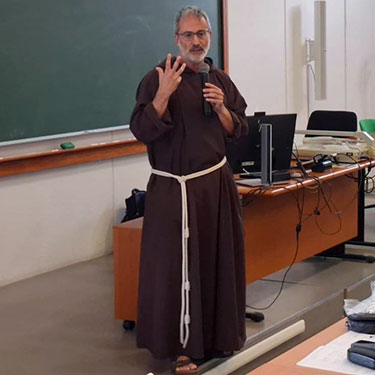
St Francis’s legacy is a long-lasting one that extends right up to the present day and has undoubtedly fostered the process of reconciliation between the Italian State and the Holy See. This was illustrated in detail by Nicolangelo D’Acunto, Director of the Department of Medieval Studies at Università Cattolica del Sacro Cuore, Monsignor Felice Accrocca, Archbishop-Bishop of Assisi-Nocera Umbra-Gualdo Tadino and Foligno, and the representatives of the State Archives of Perugia - Assisi Section, reconstructing the historical background to that evening in Assisi a hundred years ago. An extraordinary event that offers us a crucial lesson. “Major institutional turning points,” observed D’Acunto, “do not arise solely from texts, chancelleries and negotiations, but are nourished by places, symbols, gestures and shared memories, when a community manages to glimpse, even for a moment, a solution that previously seemed impossible.” Hence Monsignor Accrocca’s appeal, in the spirit of Saint Francis, the architect of peace: “Would his words find an equal audience today, when what seems to prevail is rather a brazen desire to flex one’s muscles, a tendency to exclude rather than to include, and an almost irrepressible need for belligerence?”