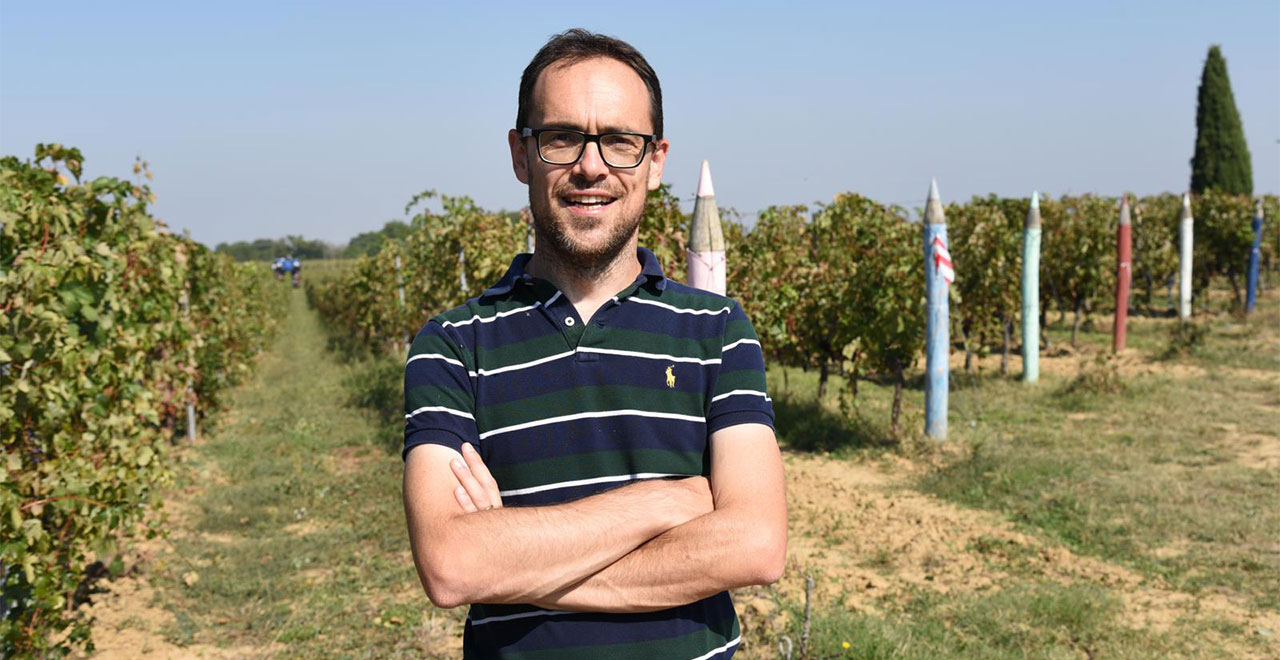
Summer droughts that are becoming longer with each passing season, heatwaves that jeopardise the ripening of grapes at the most critical stage, late frosts that damage newly developed shoots, and increasingly frequent and violent hailstorms. Climate is moving the goalposts in viticulture in Emilia-Romagna and changing the practices that have guided work in the vineyards for decades. It is from this urgent need – which is anything but theoretical – that ADAPTIVE was born, the research project run by the Faculty of Agriculture, Food and Environmental Sciences and coordinated by Professor Matteo Gatti of DIPROVES, the Department of Università Cattolica del Sacro Cuore dedicated to sciences and technologies for a sustainable agri-food supply chain, funded by the Emilia-Romagna Region through the EAFRD as part of the 2021–2027 CAP Strategic Plan.
At the heart of the project lies a question that has accompanied every vine-cultivation season in the region for some years now: how can vineyards be made resilient to the impacts of climate change, without giving up on grape quality or farm profitability? Professor Gatti and his research team have chosen to tackle the problem not merely by measuring its effects, but by testing on the field – and not just in the laboratory – tools that producers can actually adopt, tailoring them to the specific characteristics of their own estates.
"There is no such thing," Gatti points out, "as a one-size-fits-all solution capable of resolving all climate-related risks on its own. This is why ADAPTIVE does not focus on a single technique, but compares four tools already available on the market, to be tailored and validated within the specific context of regional viticulture".
In the vineyards involved in the trial, plots treated with the new techniques are compared with those managed traditionally, through agronomic, physiological and qualitative measurements carried out throughout the entire growing season. Four techniques are under observation:
- Super-absorbent polymers in the soil: substances that retain large quantities of water and release it slowly to the roots during periods of drought, improving the soil water-holding capacity.
- Reflective kaolin-based clays: applied as a white film to the leaves, they deflect part of the solar radiation, preserving photosynthetic function during heatwaves and preventing sunscald on leaves and bunches.
- Multifunctional shade nets: row covers that protect against hail, mitigate excessive radiation and regulate the microclimate within the vineyard, with positive effects on grape quality.
- Multifunctional automated irrigation: highly automated systems capable of three different functions: protection against spring frosts via a film of water that prevents shoots from freezing, cooling the microclimate on the hottest days, and providing emergency water supplies in the event of drought.
According to the project coordinator, the decision to focus on multi-purpose techniques is driven "by economic rather than agronomic considerations: in a context where profit margins are already under pressure", explains Professor Gatti, "investments capable of addressing multiple risks simultaneously will be affordable for businesses and can be rolled out on a large scale. An irrigation system that protects against frost, cools the crown and provides relief in the event of drought offers, in terms of economic return, a value far greater than the sum of its individual functions".
Launched in 2024 and running until 2027, the project already has a fully operational experimental design. For Professor Gatti, what is already clear at this early stage is that there is no single ‘right’ technique, but rather the right combination for each individual vineyard, depending on soil type, aspect, grape variety and water availability. It is precisely this knowledge that the project aims to provide to producers: not a one-size-fits-all solution, but a method for making better, informed choices.
What makes ADAPTIVE different from much of the academic research is its decision to work side by side with producers, consortia and winery technicians, with the stated aim of rapidly translating the most effective techniques into applicable protocols, accompanied by clear guidance on costs, benefits and intervention timings.
As the coordinator himself highlights, what was lacking above all were field-tested protocols capable of indicating what really works and under what conditions. Winegrowers often found themselves at an awkward crossroads: whether to invest in costly, specialised solutions targeting a single risk, or to take no action at all due to a lack of reliable guidance. Filling this gap, with the demonstrability of results as the top priority, is the research group’s stated objective.
"The expected benefits extend across several levels. Winegrowers will be able to rely on protocols tested directly in the vineyard, rather than on purely theoretical guidance. Technicians and winery consultants will have up-to-date tools to offer their clients." The Emilia-Romagna Region will be able to guide future Rural Development Programme (RDP) calls for proposals on the basis of concrete evidence, channelling public resources where they have the greatest impact. Finally, the wine protection consortia will find, in the project results, solid scientific backing to demonstrate the sustainability of the region’s production model to international markets.
Without verified and accessible tools, a significant portion of the wine-growing sector in Emilia Romagna risks facing serious economic difficulties in the face of an increasingly unpredictable climate. ADAPTIVE does not promise shortcuts, but it does outline a method: field testing, rigorous measurement, and providing producers with tools that can be tailored to the needs of their own businesses.
For Professor Gatti, the ultimate goal goes beyond the publication of scientific results: through the regional network of demonstration farms, those results are set to become the operational assets of an entire supply chain. Only in this way, he emphasises, will research cease to be an academic exercise and become a practical tool in the hands of those who, every day, must contend with a climate that is no longer what it used to be.