News | Verso il 2028
Il futuro dell’Ateneo è anche quello dei territori
Il ciclo di incontri sul Piano strategico ha mostrato il profondo legame tra i destini dell’Università Cattolica e quello delle città dove ha sede
| Redazione
14 aprile 2026
Condividi su:
“To bring to life the vision of the best university for the world – that is, for our students and for society – we are launching new initiatives ranging from the School of Knowledge Integration to lifelong learning in collaboration with a leading international digital platform,” explained Rector Elena Beccalli. “Also the method adopted is original and distinctive: it is unusual for a Strategic Plan to adopt such a participatory approach, based on the active collaboration of the entire university community, on co-design and on listening to key stakeholders, to jointly shape the University’s future for the next three years.” Not a document, but a shared process that began nine months ago, characterised by 34 thematic workshops, attended by 665 members of the University community, 1,711 respondents to the online survey and 54 project proposals submitted via the call for ideas.
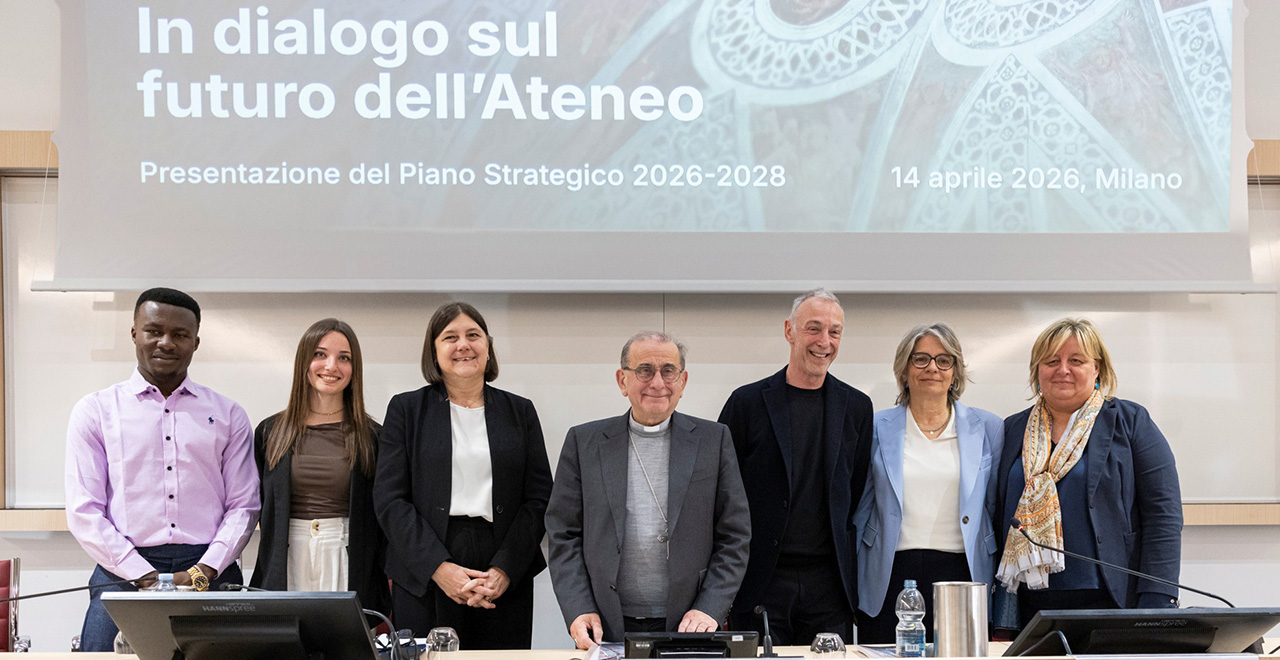
On Tuesday 14 April, in the Aula Gemelli in Milan - as it will subsequently happen at the other campuses (Brescia, Piacenza-Cremona, Rome) - it was time to give back to all those who had played a leading role in this initiative. The presentation was led by Rector Elena Beccalli and the President of the Istituto Giuseppe Toniolo di Studi Superiori, Archbishop Mario Delpini, who stated that ‘the strategic plan is not a bureaucratic formality. It is an initiative, in the sense that it declares responsibility and determination to address and guide the life of the university’.
In outlining the vision, Professor Beccalli identified the ‘three guiding principles of our institutional mission: enhancing the identity of the university as a non-profit Catholic university; promoting full integration between the roles of educational community and research university; creating a place where knowledge is experienced and not merely transmitted. This means, for example, implementing innovative educational approaches such as service learning, based on involving the student community in programmes of active citizenship and social participation, or peer mentorship, to provide mutual support amongst peers regarding content, knowledge and skills.
An article by

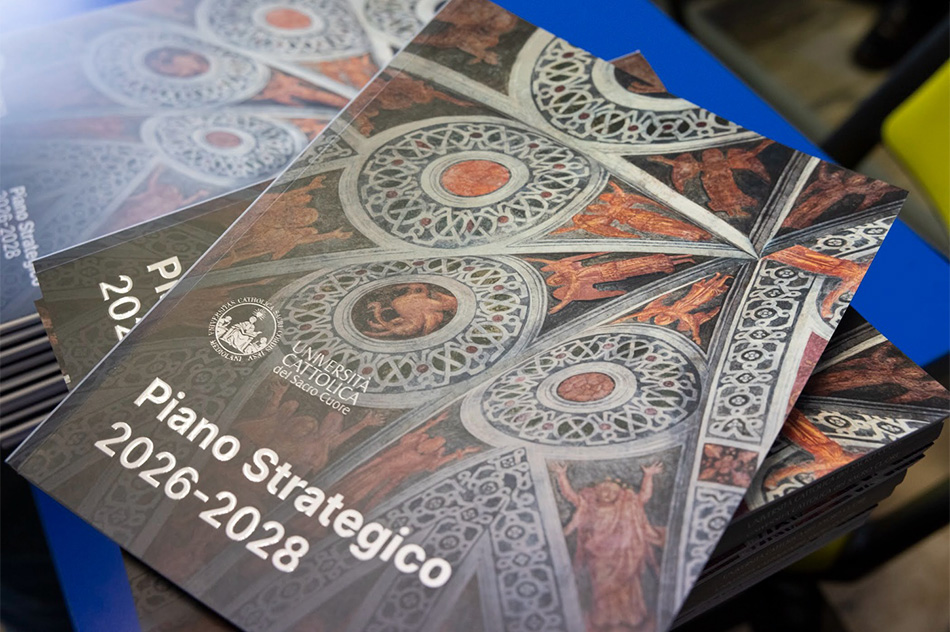
The 2026–2028 Strategic Plan is structured around five interconnected pillars, as outlined by Professor Beccalli. ‘The first pillar concerns the establishment of a School of Knowledge Integration, capable of enhancing the University’s interdisciplinary approach in addressing the major issues of our time from a cross-cutting perspective, thereby avoiding the risk of skill fragmentation.’
The second pillar refers to the valorisation of research and researchers, “with the aim of further strengthening our profile as a research university. In other words, the intention is to promote a favourable research environment capable of attracting and supporting young researchers through incentives and awards.”
The third pillar is based on ‘a high-quality educational offer that enhances the learning experience in both physical and digital spaces, aiming at the full development of the educational community. This is also achieved through an update of course content and teaching methodologies, with particular attention to artificial intelligence tools and the development of courses in collaboration with the international digital platform FutureLearn, to provide training that spans the entire professional career.”
The fourth pillar concerns internationalisation and follows two main strands. “On the one hand, expanding our global dimension through accreditations, a focus on rankings and the introduction of further dual degree programmes in addition to the 112 already in place; on the other, a more identity-based approach, inspired by solidarity, aimed at continuing the implementation of the Africa Plan.”
Finally, the fifth pillar is dedicated to fundraising activities “by drawing on our core values and institutional principles, guided by the idea of giving as a form of reciprocity. The aim, therefore, goes beyond the mere collection of resources and encompasses the strengthening of relationships with alumni and external partners to support strategic projects and ensure access to our programmes for deserving young people who lack the financial means to do so”.
.jpg)
.jpg)
.jpg)
.jpg)
.jpg)
.jpg)
.jpg)
.jpg)
.jpg)
According to Archbishop Mario Delpini, ‘the intention that the Istituto Toniolo advocates and for which it feels responsible is to propose, with conviction, a commitment to work, study and research for the sake of the person and not the idol, with priority reference to the vocation to which God calls us and not to statistics, with the awareness of a mission to be fulfilled to make the world habitable, thinking hopeful, and coexistence and solidarity desirable’. This is why “through its strategic plan, Università Cattolica reaffirms itself as the expression of a Catholic presence that encourages research autonomy whilst, at the same time, gratefully expressing its belonging to the Italian Catholic Church and to the international community”.
Linus, artistic director of Radio Deejay, spoke about how the university becomes a place for experiencing knowledge. Addressing an audience of professors and lecturers, administrative staff and students, he engaged in a discussion with three members of the university community: Margherita Lanz, full professor of Methodology of Psychological Applied Research, Jolie Casalini, a student at the Faculty of Political and Social Sciences, Richard Luwate, a student from South Sudan studying Finance, and Maddalena Baitieri, from the Research Office.
What emerged was a spirited account by Linus, who wittily described himself as “the Rector of Radio Deejay”. The conversation gave a real sense of the collaborative effort and the distinct feeling that something new was taking shape, as Jolie remarked, pleasantly surprised to see students on stage, or as Professor Lanz pointed out (“in all my years, I’ve never seen anything like this”). The most difficult part comes now, as explained by Maddalena Baitieri, who from tomorrow will be dealing with the challenge of ‘inventing a source of funding for young researchers’. Representing the internationalisation process and the implementation of the Africa Plan was 25-year-old Richard from South Sudan, who arrived at Università Cattolica thanks to the Unicore project, University Corridors for Refugees, coordinated by UNHCR. “Inclusivity at Università Cattolica is palpable. But I know I need to become more fluent in the language of the country that has welcomed me in order to keep on improving my knowledge of banking subjects and perhaps, who knows, make them available in the future to the part of the world I come from to help others.”
Voices of people representing many others who, as Rector Beccalli concluded, worked together on ‘a plan to build the future of our University together and write a new chapter of our history’.
Il ciclo di incontri sul Piano strategico ha mostrato il profondo legame tra i destini dell’Università Cattolica e quello delle città dove ha sede
| Redazione
Studenti, docenti e personale raccontano il Piano strategico
| Redazione
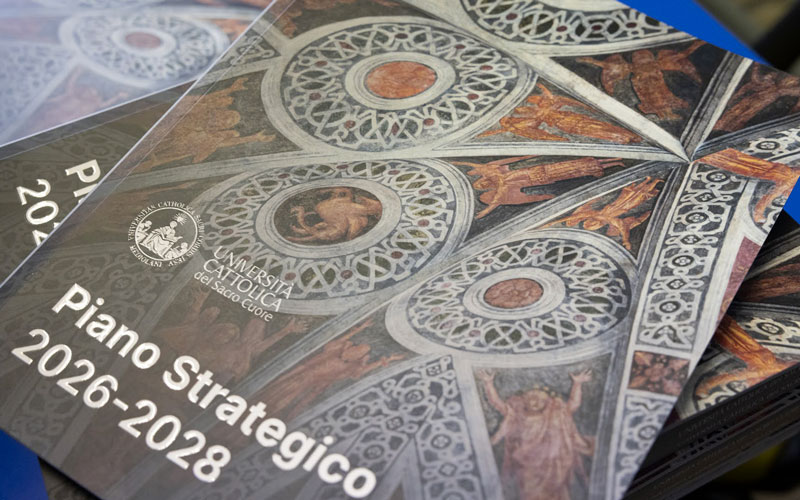
Tutto quello che occorre sapere sul documento che descrive i prossimi tre anni dell'Ateneo
| Redazione