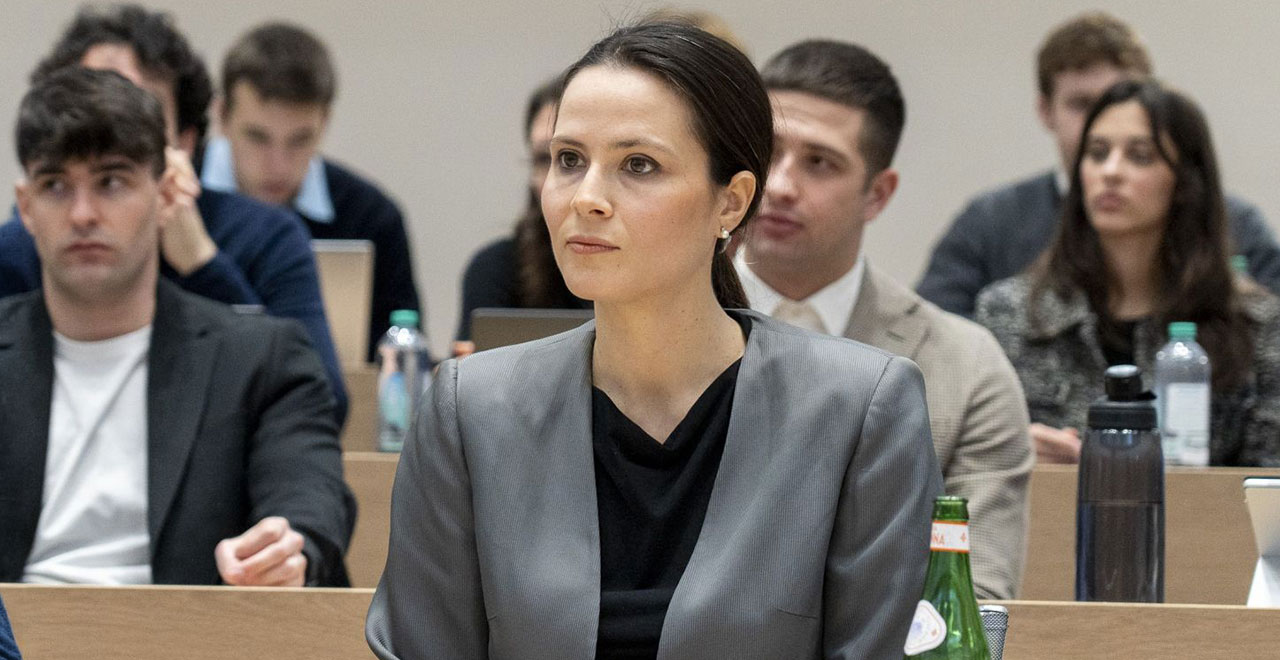
A €1.2 million grant from the Italian Science Fund (FIS) brings Esmeralda Colombo, principal investigator of the Governing AI for Innovation and Energy Justice (G-AI-A) project, back to Università Cattolica. After almost ten years abroad, Esmeralda Colombo returns to the University where she graduated as the winner of the prestigious FIS 3 - Starting Grant (€1,181,107.93), the first awarded to a Faculty of Law at Università Cattolica under the Competitive Procedure for the Development of Fundamental Research Activities, funded by the Italian Science Fund 2024–2025 (FIS 3 Call), promoted by the Ministry of University and Research.
The project aims to transform Artificial Intelligence from a ‘resource-hungry’ technology into a catalyst for an energy transition that puts the dignity of humanity and the planet back at the centre. The research starts from an observation: after more than three decades of climate policies, energy systems still account for over three-quarters of global emissions. In Europe, hit by yet another energy crisis, where an abundance of renewables clashes with fragmented markets and muted incentives, a new critical variable is emerging: Artificial Intelligence. Whilst being the driving force behind innovation, AI ‘devours’ energy in an often uncontrolled manner, risking further environmental damage. The G-AI-A project targets this gap, defining obligations and incentives – through a reform model based on international regulatory principles – that elevate technological innovation from a mere market experiment to a pillar of a fair and regulated energy and digital transition. “Current international law is proving incapable of governing AI in the energy sector, limiting itself to reactive and fragmented regulation that prioritises short-term economic considerations at the expense of innovation and energy justice,” Colombo explains. “G-AI-A aims to overcome this institutional paralysis by transforming AI into a powerful driver for clean technologies, capable of channelling the animal spirits of cleantech companies towards objectives that are both efficient and sustainable.”
The objective is ambitious and also includes the drafting of a Global Charter for AI in energy systems. The five-year project will draw on the expertise of an international Advisory Board (Australian National University, OECD Observatory of Public Sector Innovation, Harvard University, Politecnico di Milano, Centre for Research on Risk and Crises École des Mines – ParisTech, University of Bergen, Norway) and will engage directly with Milan’s innovation ecosystem, testing its models with businesses and a university-based deep-tech incubator that specialises in the analysis, development and commercialisation of cutting-edge technologies derived from advanced scientific research.
The G-AI-A project will be based at the Faculty of Law at the Milan campus, where Dr Colombo will be affiliated with the Institute of International Studies. Her application to the FIS was developed under the supervision of Professor Gabriele Della Morte, Full Professor of International Law at the Faculty of Law and Principal Investigator of the University project “Public functions, private control. Interdisciplinary profile over the governance without governance of algorithmic society”. It was precisely the strong interdisciplinary nature of the research conducted at Università Cattolica that guided Esmeralda Colombo’s academic choice. As an alumna of the University, the common thread running through her current work can already be found in her dissertation on criminal law and criminal policy, which provided her with a rich humanistic foundation for the studies she is currently pursuing. “In every proposed innovation or reform, the focus remains on human dignity and care for the planet: a necessary perspective for governing technologies that otherwise risk slipping beyond regulatory and ethical control,” says the young researcher.
AI as a means, not an end
The core of G-AI-A lies in moving beyond the technocratic approach to AI. Colombo warns against the risk of a “scotomisation of the human condition”, a sort of “blind spot” where automation obscures political judgement and democratic participation, even in recent UN initiatives. “Artificial intelligence must not be the end, but the means, the lever for innovation and energy justice. The current paradox is that AI consumes energy in a largely unregulated manner. G-AI-A was created precisely to investigate whether and how digital innovation can, instead, enable energy systems that are both sustainable and socially equitable.”
A global response to the crisis
As Colombo explains, to those who pit innovation against the law, the answer is plain for all to see: without targeted regulations, we risk failing to do what we know is right – namely, choosing clean energy and more efficient industrial systems thanks to the innovation offered by AI, rather than as an alternative to it. “The current geopolitical and energy instability, in fact, confirms the urgency of a form of sovereignty that is not just about supply, but regulatory resilience.” G-AI-A will develop the first global framework for the design and use of AI in energy systems, based on digital rights, justice indicators and compliance standards for the so-called ‘twin transition’ (digital and green).
The project’s Scientific Committee
The project draws on a transatlantic and inter-institutional Scientific Advisory Board, which includes, amongst others: Anthea Roberts (Australian National University), on AI governance models in international law and reform proposals inspired by the Risk-Reward-Resilience paradigm; Piret Tõnurist (OECD – Observatory of Public Sector Innovation), for AI innovation ecosystem policies in the energy sector; Shannon Vallor (The University of Edinburgh), for the development of ethical and legal impact assessments; Mathias Risse (Harvard University), for the development of a ‘Global Charter’ for AI legal research in energy systems; Enrico Zio (Politecnico di Milano / École des Mines ParisTech – PSL), for use cases on regulatory sandboxes and testbeds; Kjersti Fløttum (University of Bergen, Ordre national du mérite), for the development of policy narratives to support the AI Literacy Hub, which will be launched during the project for participatory AI policies for clean energy; Giuseppe Riva and Gabriele Della Morte (Università Cattolica del Sacro Cuore), for scientific consultancy on the human, social and regulatory impact profiles of AI, in terms of General Psychology and International Law, respectively.