NEWS | Dies Academicus

Food as an act of intergenerational justice

12 marzo 2026

Food as an act of intergenerational justice

Condividi su:

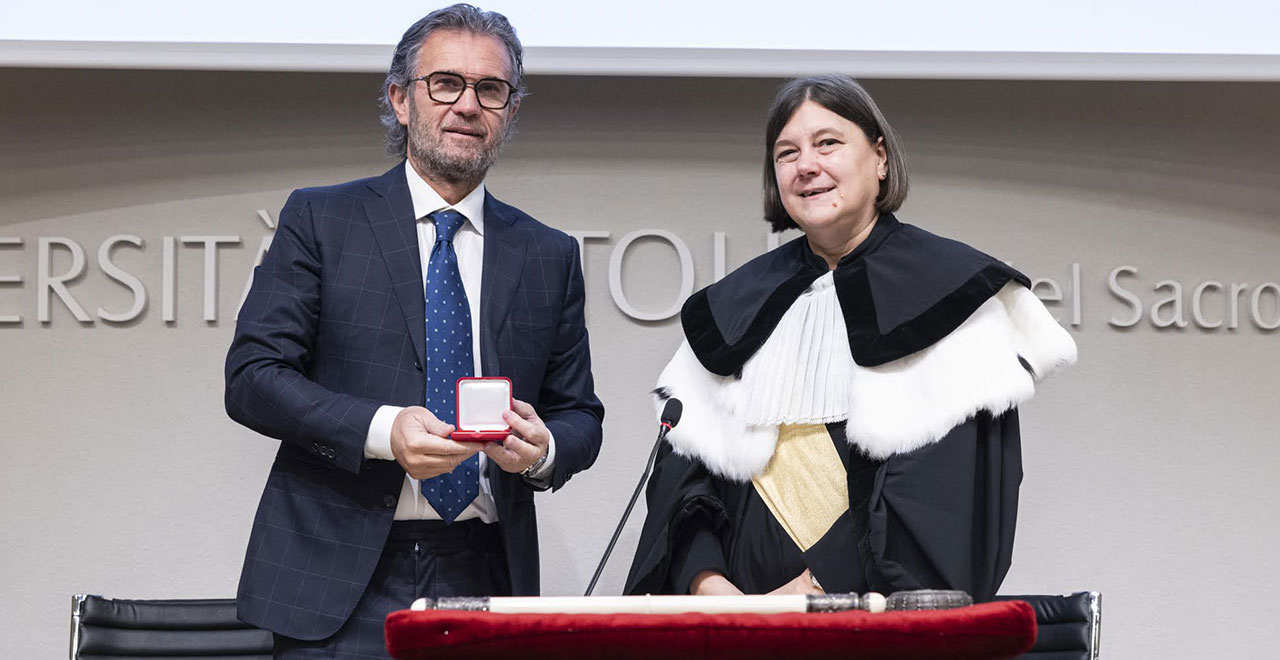
A dies academicus at the Piacenza-Cremona campus dedicated to nutrition, sealed by Carlo Cracco, who gave the opening address. According to the Rector of Università Cattolica del Sacro Cuore, Elena Beccalli, “with the creativity of his dishes, he has helped to make Italian cuisine a global symbol.”

The Rector’s inaugural speech began with two assumptions related to the alliance between generations: “In an era marked by unprecedented demographic transition, the combination of nutrition and longevity represents a new frontier in human rights. Furthermore, ageing should not be understood as a process of subtraction, but rather as an extension of human dignity, which is also ensured by food choices. These two assumptions encompass the interdisciplinary universe at the heart of the activities of the Piacenza and Cremona campuses.”

On the first front, “longevity means not only adding years to life, but life to years. This testifies to the link between nutrition, longevity and human rights”. But the issue of proper nutrition also affects the younger generations. “In 2026, the global scenario describes a paradoxical reality: for the first time in history, the number of obese children and adolescents has exceeded that of underweight children and adolescents.” This is “a political issue in the broadest sense, a social issue of the highest order.”

Professor Beccalli has called for a shared commitment between institutions, communities and the world of research to take action. “I call on institutions to fully recognise clinical nutrition as a primary component of essential levels of care. On communities to rediscover the value of shared meals, a powerful antidote to loneliness, which in turn is one of the most insidious causes of malnutrition. Finally, on science, to continue innovating in the field of Food Technology without ever losing sight of the centrality of the pleasure of taste and the quality of the food experience.” A concrete response is the creation of a new centre of excellence for research on longevity on the Cremona campus, launched with Bocconi University, with the support of the Fondazione Invernizzi.

An article by

Editorial Staff

Editorial Staff

Condividi su:


The Rector also pointed out that “if man is what he eats and if our humanity depends on responsibility towards others, then ensuring nutritional security is an act of universal and intergenerational justice.” For this reason, “combating food poverty and clinical malnutrition is not only a health objective, it is the only way to live in a society that can still call itself civilised.” It is necessary to assign importance to social and environmental sustainability, as well as economic sustainability, implying that development in the present should not be achieved at the expense of the future. “This refers to a principle of intergenerational justice, based on an alliance between generations.”

Chef Carlo Cracco also spoke about this in his opening speech, where he expressed the essence of cooking, which “is not just a set of techniques or an expression of individual creativity: it is above all a cultural heritage that develops and enriches itself through the transmission of knowledge, experience and values between teachers and students.” As the most significant figure in the alliance between generations, the chef recalled Gualtiero Marchesi, who “is not only a great chef, but also a master capable of training and inspiring entire generations of professionals.”

In the evolution that cuisine has undergone over time, Carlo Cracco placed great value on “the idea of a brigade that works as a team. Each person contributes their own talent, sensitivity and energy. My job as a chef is to create the conditions for these qualities to be expressed in the best possible way.”


According to the chef, the history of cuisine is the result of an alliance between generations, based on a very clear principle: “Innovation never arises in isolation, but from the encounter between experience and the future. Each generation builds its own path starting from the foundations laid by those who came before. It is precisely in this continuous dialogue between teachers and students, between organisation and creativity, between memory and change, that I recognise the true strength of gastronomic culture: an authentic alliance between generations.”

In her speech, Rector Beccalli did not fail to mention the new developments at the Piacenza-Cremona campus. In Piacenza, “the innovations will affect the Undergraduate degree programme in Economics and Management for Sustainability, the Undergraduate degree programme in International Management and the Graduate degree programme in Management. In Cremona, on the other hand, the Graduate degree programme in Management and Digital Innovation will be revamped.” Also in Cremona, “the Specialising Master Programme in Artificial Intelligence and Data Science for Businesses has been launched, the result of collaboration with the Politecnico di Milano, based on a genuine logic of co-opetition.” And in the Lombard city, thanks to the support of the Fondazione Arvedi Bruschini, a new residence will open next academic year, accommodating 70 students and Visiting Professors. In terms of research, 2025 was an exceptional year, “the best ever in terms of attracting resources and projects. A total of 177 new research projects were registered, worth almost €11 million,” said the Rector, without forgetting the University’s ongoing commitment to the Africa Plan with ten projects.

The mayor of Piacenza, Katia Tarasconi, the sole administrator of Epis, Monica Patelli, and former student and PhD student Rebecca Mariani also spoke at the dies academicus. The mayor reaffirmed that for a city like Piacenza, being able to count on a dynamic and qualified university is a great opportunity. It means attracting young people from many parts of Italy and also from abroad. It means generating cultural exchanges, relationships and new ideas.” The representative of Epis and president of the Province invited everyone to “work together, pooling everyone’s skills, especially those of our young people, who are both the present and the future, to offer our communities and citizens a Michelin-starred menu in which the territory and its people are the protagonists.” Rebecca Mariani closed the ceremony by describing the University as “a place where generations can dialogue, meet and sometimes clash, but always in a constructive way.”

Newsletter

Scegli che cosa ti interessa
e resta aggiornato

Iscriviti