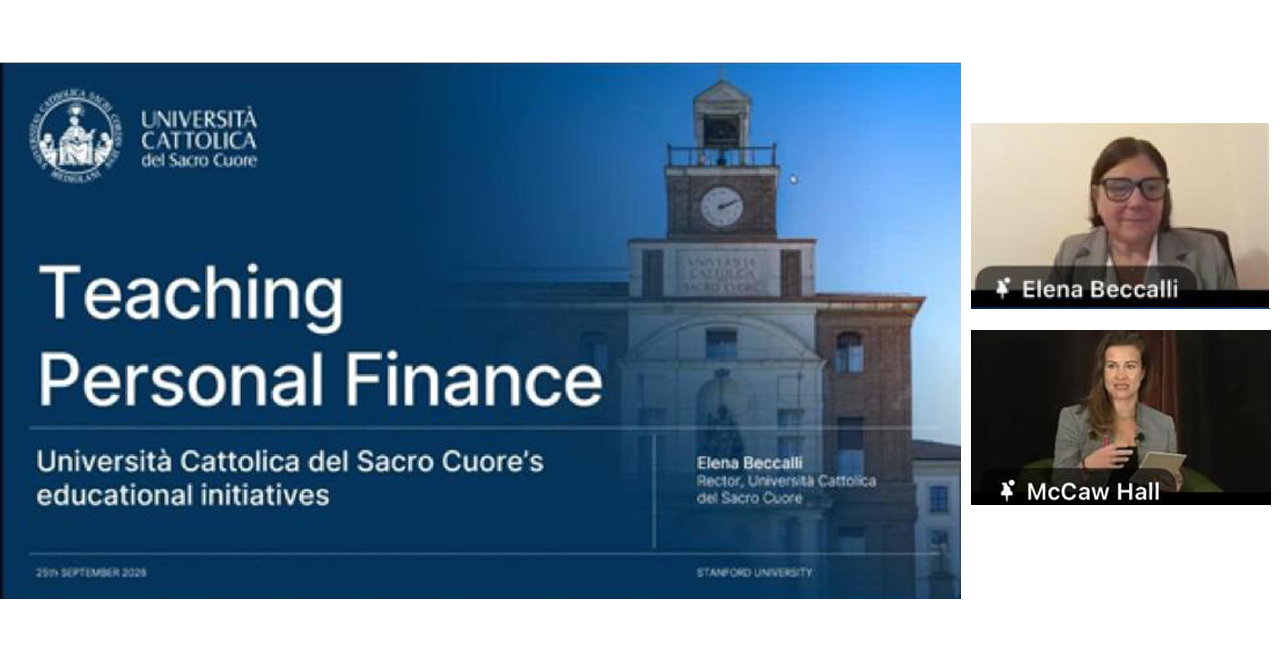
From students not specialized in finance-related disciplines to primary and secondary school teachers, vulnerable people and migrants: these are the target groups for the personal finance initiatives developed by Università Cattolica del Sacro Cuore to promote financial literacy and strengthen economic awareness and skills. Rector Elena Beccalli presented the University’s educational activities at Stanford University on Friday, 25 September, during the “2026 Teaching Personal Finance Conference”. Organised by Stanford’s Initiative for Financial Decision-Making, directed by Annamaria Lusardi, the conference brought together teachers, researchers and specialists to share experiences, teaching methods and research projects.
“It was a privilege to present our University’s work on personal finance at Stanford University. This is a concrete way to contribute to Italy’s development, fostering resilience and social inclusion, at a time when financial education remains below the European average,” said Rector Elena Beccalli. “Our projects serve students not specialized in finance-related disciplines through courses in basic financial skills; primary school children through programmes designed for younger learners; and teachers through training that supports the inclusion of financial topics in civic education. Alongside these initiatives, a project for vulnerable people, particularly migrants, combines financial literacy with language learning. A wide range of activities that originated from the collaboration of expert professors in finance and professors from other disciplines within the University, a dialogue that was widely shared. A growing number of professors are spending their expertise on this work, well aware of its social impact” stated Rector Elena Beccalli in front of the audience of experts gathered at Stanford.
Università Cattolica del Sacro Cuore’s commitment reflects priorities set by the European Union, which in 2025 described financial literacy as an essential life skill that enables citizens to make informed and responsible economic decisions. Eurobarometer data from 2023 underscore the need for action: fewer than one in five European citizens, or 18%, have a high level of financial literacy. Italy continues to lag behind, with significant gaps linked to gender, age and geographical area.
Personal finance initiatives at the University
Università Cattolica del Sacro Cuore has therefore developed a broad range of initiatives. These include the Personal Finance Workshops for students not specialized in finance-related disciplines. Initially launched through the Faculty of Linguistic Sciences and Foreign Literatures and the School of Banking, Finance and Insurance, supervised by Professors Maria Cristina Gatti, Francesca Pampurini and Alberto Banfi. Following the pilot, the project is expanding to other faculties and, in the current academic year, also involves Psychology and Education through an interdisciplinary collaboration.
This experience has also led to an initiative for secondary school teachers: the course ‘Personal Finance at School: Educating Informed Citizens’, offered through the Cattolica per la Scuola platform. A practical example of lifelong learning, it has two aims: to enable teachers to guide students through everyday and future economic and financial choices, and to give teachers the knowledge and tools to make more informed financial decisions in their own lives.
A further initiative, ‘Educated to Educate: Financial Education for Civic Education’, is also offered through Cattolicaper la Scuola. Taught by Federica Poli and Mariarosa Borroni, it seeks to raise secondary school teachers’ awareness of the importance of financial education and provide resources for systematically integrating it into civic education curricula.
For children, the Economic Psychology Research Unit in the Department of Psychology is developing a primary school programme on managing money ‘using the head’, through informed, critical choices, and ‘with the heart’, by considering others and the social implications of one’s decisions, including when using new technologies. This approach informs the 2026 book Consapevoli fin da piccoli (Growing awareness from an early age, edited by Silvia Della Rocca, Christian Tarchi, Elisabetta Lombardi and Annalisa Valle). The book proposes an integrated model for primary schools that places financial education in an interdisciplinary framework, linking economic skills with the cognitive processes underlying decisions, prosocial attitudes and a critical understanding of citizenship.
For vulnerable people, the University has launched a financial education programme for people from different cultural backgrounds and low-income families in collaboration with several Milan-based associations, including Associazione Realmonte. ‘IBAN’, developed by Professor Annalisa Valle, takes an innovative approach that combines financial literacy with Italian language learning. Alongside economic and financial education, a language module teaches the vocabulary needed to understand concepts and tools used in everyday economic life. Participants also actively contribute to a shared glossary and produce short videos on financial education topics.
The University’s work also includes numerous outreach and public engagement activities under its Third Mission, supporting greater financial awareness beyond academic and school settings. These are complemented by ‘Women in Finance’, a programme designed to strengthen women’s representation in the financial sector and reduce gender gaps in economic skills and career opportunities.