News | Brescia
Un campus glocal al passo con i tempi
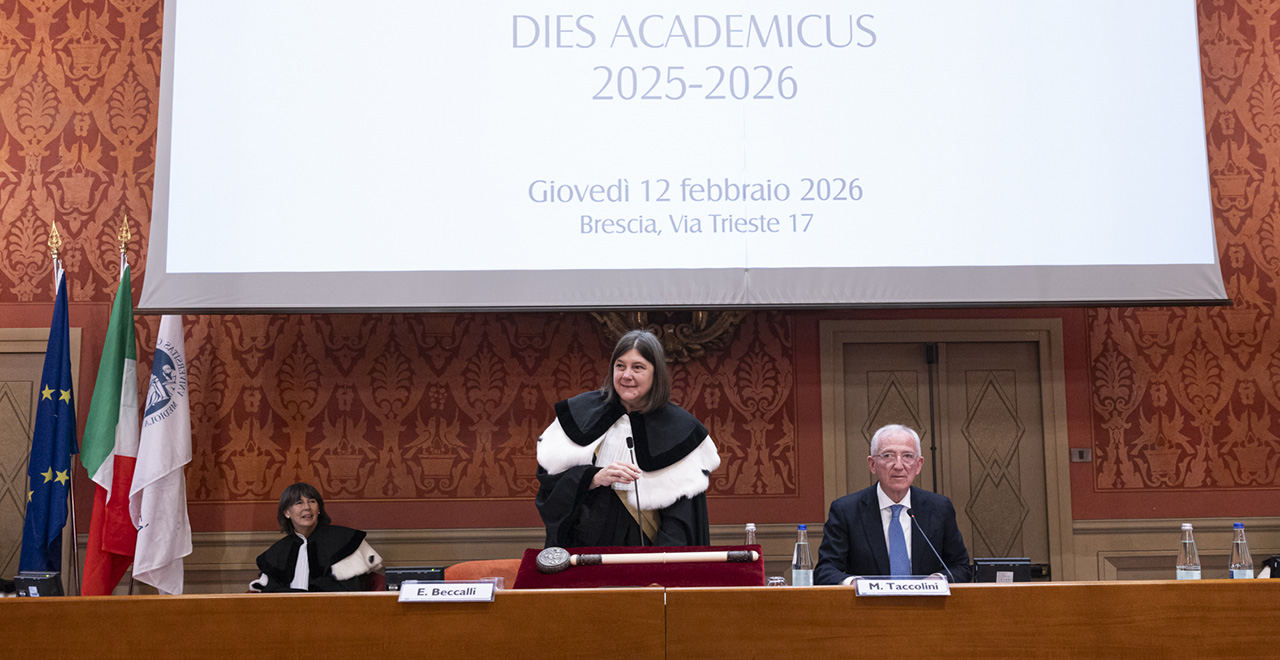
Il discorso della Rettrice dell'Università Cattolica del Sacro Cuore, Elena Beccalli, in occasione dell'inaugurazione dell'anno accademico 2025-26 della sede di Brescia
| Elena Beccalli
12 febbraio 2026
Condividi su:
The alliance between generations is also the theme chosen for the Dies celebration at the Brescia campus of Università Cattolica del Sacro Cuore. This time, it is approached from a socio-political perspective, “which has always been at the heart of our University’s scientific and educational tradition and, in Brescia, has been particularly developed for over a decade”, as explained by Rector Elena Beccalli in her inaugural speech.
Before addressing the theme that is the common thread running through all the Dies events of the current academic year, her speech highlighted the new developments and strengths of the Brescia campus. These include new degree profiles: “Educator in Early Childhood Education Services” and “Professional Socio-Pedagogical Educator” within the undergraduate degree programme in Sciences of Education and Training Processes; “Climate change and management of environmental risk” in the graduate degree programme in Physics and “We inhabit Sport: the psychologist’s intervention” in the graduate degree programme in Psychology of clinical interventions: groups, organisations, communities. “These pathways meet the emerging demands of the job market, providing innovative skills and to promote qualified and cutting-edge training,” said the Rector.
Another initiative that highlights the specificity of the Brescia campus is its service-learning programme, which has involved 300 students in 15 projects since 2022. This pedagogical approach concretely translates the idea of the university as a “place of learning experience” ‒ as physics student Andrea Negrini testified in his speech ‒ and involves the student community in active citizenship and social engagement. “A concrete example of what it means to be the best university for the world.”
The Brescia campus also proves to be a “global microcosm”, with 62 international students enrolled with a foreign degree, which, added to those born abroad who have completed their studies in Italy, make a total of 130, “a figure that says a lot about the attractiveness of the location for second-generation young people.” This is in line with “the commendable ranking of our University certified by QS World University Rankings: Europe 2026,” forwhich “we are the leaders in Italy for both incoming and outgoing student mobility.”
An article by
On the research front, the Rector praised the funding of over one million euros obtained by the young physicist Giada Bianchetti in the FIS 3 (Italian Science Fund) call for proposals for a high-impact study on the metabolism of brain tumours, carried out thanks to a multidisciplinary project involving the expertise of the I-Lamp research centre in the field of quantum technologies.
Returning to the narrative thread of this academic year, the Rector pointed out that “intergenerational justice” ‒ “a necessary and essential pillar for ensuring social cohesion and the development of our country” ‒ lies at the heart of the alliance between generations. As Rector Beccalli explained, “this is based on principles enshrined in our Constitution, on the promotion of wide-ranging policies for the common good, and on real social and economic sustainability. The Brescia campus of Università Cattolica del Sacro Cuore can continue to make an essential contribution to realizing this vision. To do so, its glocal dimension must be strengthened and kept in step with the times.”
Which approach should be adopted? “The European Commission’s recent proposal for a new pact between generations” represents “a genuine Intergenerational Fairness Strategy with allocated resources.” This shows that effective collaboration between generations is encouraged across Europe. “This is something that is very much on the minds of the faculty at the Brescia campus, where there is now a well-established tradition of studies focused on international dynamics, which will need to be brought to full maturity in the near future.” “When we decided to launch programmes in the Faculty of Political and Social Sciences on this campus over ten years ago, we were driven by the conviction that in order to understand global dynamics, it was necessary to train young people with a critical and constructive approach, capable of navigating cross-cutting fields such as politics, law, economics and social issues. It was ‒ and still is ‒ a forward-looking choice, fully in line with our University’s ethos.”
Getting to the heart of the matter, Enrico Giovannini, economist, co-founder and scientific Director of the Italian Alliance for Sustainable Development (ASviS), explained that sustainable development “is not just an environmental issue, but a question of justice ‒ especially intergenerational justice”. “This is the definition of sustainable development: development that meets the needs of the present without compromising future generations’ ability to meet their own.” Citing a report produced by ASviS with Oxford Economics, Giovannini revealed worrying data if climate change is not tackled. Looking at the scenarios for 2035 and 2050, it emerged that by mid-century, the average temperature increase will reach 2.4°C: “We know that Europe is warming more than the rest of the world and Italy more than the rest of Europe.” We need to be aware that “postponing action is a bad choice for economic reasons, not just environmental ones. Decarbonisation alone entails a short-term cost but long-term benefits. If we make a major investment in innovation as well as decarbonisation, positive results can be achieved quickly.” The good news is that, according to Istat, “Italian manufacturing companies with more than 10 employees that have invested in sustainability generate 16.7% more added value than those that have not invested: therefore, it is not true that sustainability is a cost.”
According to Giovannini, Europe is ahead of everyone else in terms of intergenerational justice, both for having introduced the Youth Check, along the lines of Italy’s Generational Impact Assessment, adopted in 2025 on ASviS’ initiave, with the aim of “offloading the costs” of today’s choices onto future generations, and for having appointed a commissioner dedicated to generations, Malta’s Glenn Micallef. “The Europe we criticise so much is the most sustainable place in the world and the most advanced in terms of legislation. More rules could prevent 300,000 premature pollution-related deaths per year, many of which are in Italy, around 67,000 ‒ many of which are in the Po Valley, the most polluted area in Europe.” This is why we need a pact for the future ‒ a paradigm shift that requires the recognition of future generations’ rights.
In concluding her speech, the Rector pointed to a shining example for the university community, Laura Bianchini from Brescia, a founding member of the Italian Parliament, teacher and two-time graduate of the University founded by Father Gemelli. The Brescia campus will honour her with a dedicated lecture hall on 2 June. “In her words,” concluded Professor Beccalli, “we find the essence of the alliance between generations and our educational method: accompanying each student in discovering their vocation and, at the same time, recognising their responsibilities towards others, aware that all this matures within a network of authentic and shared relationships.”
The Dies celebration in Brescia was also attended by the Mayor of Brescia, Laura Castelletti, who described Università Cattolica as “an important pillar of our educational and cultural landscape for 60 years, forming generations of aware citizens and active participants in community life”; the Regional Councillor for Education, Training and Employment, Simona Tironi, who emphasised that “the alliance between generations commits our political work”; Bishop Pierantonio Tremolada spoke of Università Cattolica as “a place where the mind is formed from the heart”; while the President of the Brescia Higher Education Authority (EBIS), noted that “the University’s Brescia campus has shown significant and growing cultural vitality in recent years, developing a series of substantial and lasting relationships with the economic and entrepreneurial fabric. EBIS intends to strengthen this connection by continuing to support projects in this direction, as well as faculty and students at the campus who intend to propose them'.