In recent years, many people have been talking about the circular economy, one of the cornerstones of both the European Green Deal, the growth strategy presented by the European Commission in December 2019, and the National Recovery and Resilience Plan.
"But no one tells us how to implement it at the level of civil society, what the implementation of the circular economy implies for the community, what a huge change in mentality, habits, practices it entails. We are asked to use other people's waste, to stop buying and owning, favouring borrowing, exchanging, bartering, renting".
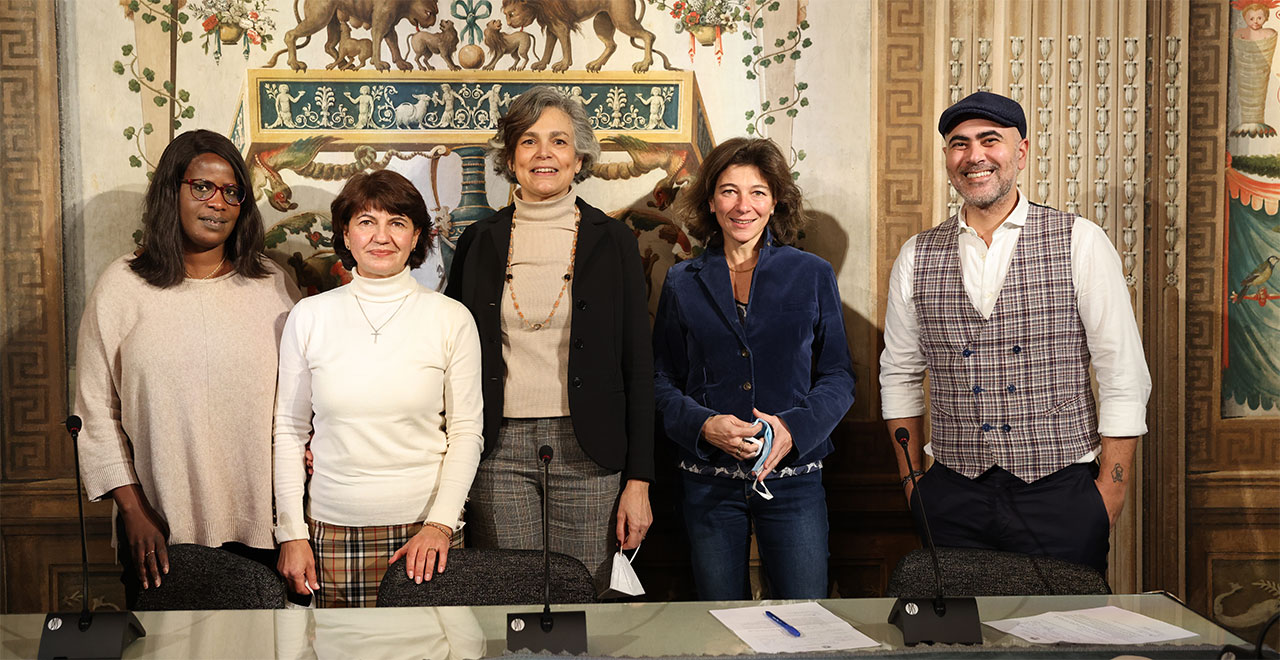
These were the starting points delivered by Ilaria Beretta, Professor in Urban and Environmental Sociology, for the multipolar conversation 'Building a multi-ethnic climate-neutral society', held at Università Cattolica on Monday 29 November. The second of the New European Bauhaus project, an initiative that aims to build a community aesthetic to make the encounter between the different social and ethnic components of our cities fruitful and beautiful.
But how can we build a society that is both multi-ethnic and carbon-neutral? What can we learn from the cultures of origin of our fellow citizens in terms of the circular economy? What are the winning ideas that we can retain and pass on?
Some ideas from around the world were suggested by four fellow citizens from Brazil, Senegal, Romania and Palestine.
Awa Kane, a student at the Faculty of Political and Social Sciences, comes from Senegal and recounts how in her country neither water nor food could be wasted. "When mutton was killed on feast days, the leftover meat was salted – there was no refrigerator then – to be eaten during the winter, and the skin was used to cover the drum. Today, we can afford a little more and we import European objects, which are thus given a second life".
Gabriela Palade, who grew up in Romania during the communist period and has been a school operator in Italy for many years, knows what it means to have very few things to eat and wear. "There was very little waste because clothes were recycled and toys were made from the materials available. Today, 44% of the population live in the countryside and make extensive use of plants to cure themselves".
Simone Silva, a cultural mediator who arrived from Brazil many years ago, remembers her indigenous grandmother and her twenty children. "I didn't know then that it was called circular economy, but she passed on to us the concept of sustainability, of taking care not to waste food. I lived in northeast Brazil and there are big inequalities there, with favelas on the outskirts of the city where people from the countryside are concentrated. Today, however, these poor people do a job that is useful to everyone: they clean up the cities of waste by collecting it on carts, then separating and recycling it. This is a non-legal way of keeping the city clean and making some money. Others, on the other hand, collect bicycles discarded by white people and take them to the favelas, giving these families the chance to take their children to school and access the city's services".
Managing food wisely was not a choice for Yias Ashkar when he was in Palestine at the time of the curfew. "We had a house full of jars of preserved food that we shared with neighbouring families. Another example of economy was the weddings, which as you know in my country are always massive – 500 to 660 people. After the feast, the leftover food would be packed up and redistributed to the poor of the city". Today Yas is a restaurateur in Brescia and tries to implement the concepts of sustainability by carefully managing the ethnic food he prepares for his customers.
The third NEB meeting will be on 9 December, again in Milan in the Sala Fontana of the Museo del '900, and will be coordinated by ASA (Graduate School of Environmental Studies) and ASGP (Graduate School “Federico Stella” of Criminal Justice). This third appointment will focus on the theme of environmental sustainability, highlighting the experiences of different cultures to combat climate change and promote forms of circular economy.