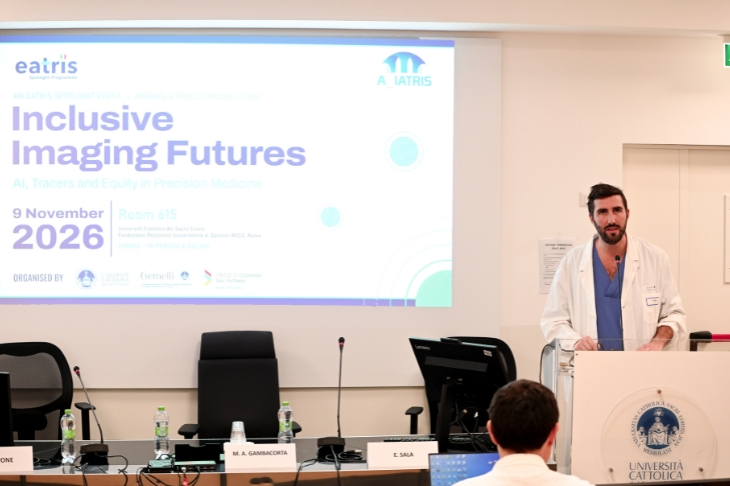
This was followed by two in-depth study sessions, which sparked a collaborative discussion involving university professors and lecturers, representatives of the EATRIS consortium, institutions, patient organisations and industry.
The first session, entitled “Inclusive Imaging Ecosystems: AI, Tracers and Equitable Translation”, moderated by Dr Salvatore Annunziata, focused on the role of imaging, artificial intelligence and tracers in supporting equitable precision medicine, capable of including the most vulnerable and underserved populations across different healthcare settings. The session opened with a patient’s perspective: in a video message, Catherine Bouvier Ellis (Oncidium Foundation) emphasised that “access is not a privilege: every patient deserves the information, support and voice needed to access targeted radionuclide therapy, wherever they are in the world”. Dr Daniele Pizzuto, medical director of the Nuclear Medicine Unit at Fondazione Policlinico Universitario Agostino Gemelli IRCCS, presented the European networks MIRROR and PROMOTE, established as part of Thera4Care, the European project coordinated by Università Cattolica and Policlinico Gemelli to build an integrated ecosystem for theragnostics. Dr Alberto Traverso, Scientific Director Clinical Data Science at the Centre of AI of Università Vita-Salute San Raffaele and Ospedale San Raffaele IRCCS, outlined the process of creating ‘digital twins’, from platform development to clinical use, in which equity cannot be taken for granted but must be verified at every stage, identifying where and for which patients each model fails to work. Finally, Dr Sara Zullino (EATRIS) shared with the audience the experience of EUCAIM, the European federated infrastructure for oncological imaging supporting the development of artificial intelligence.
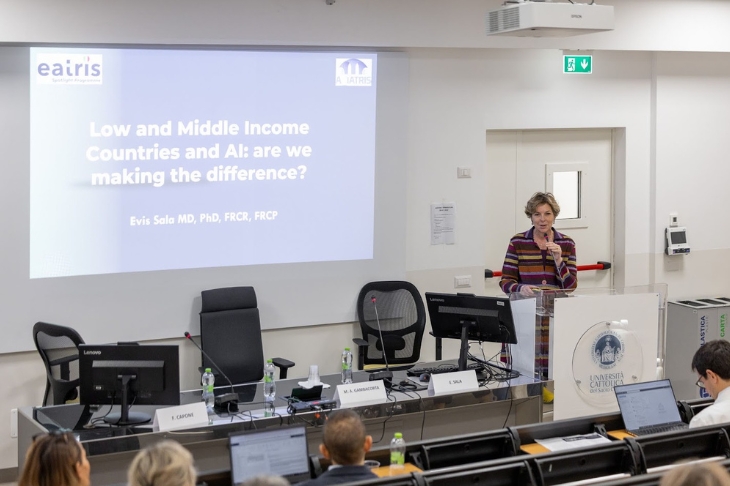
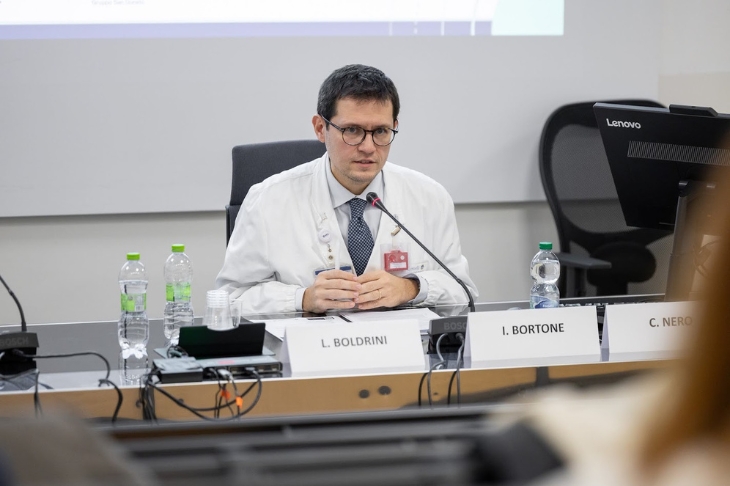
The second session, entitled “From Translational Research to Policy Uptake and Real-Life Implementation”, moderated by Dr Luca Boldrini, addressed the transition from translational research on imaging, AI and tracers to health policies and real-world practice, with a view to supporting the transformation of healthcare systems. Professor Americo Cicchetti, Professor of Business Organisation at Università Cattolica, presented the Health Technology Assessment (HTA) pathways for taking artificial intelligence and digital health from innovation to adoption, particularly in light of the European EDiHTA project – coordinated by the University – which is meant to develop a European HTA framework for digital technologies and artificial intelligence. Professor Fidelia Cascini, of Istituto Superiore di Sanità and Italy’s representative on the EU Committee on the European Health Data Space (EHDS), emphasised that trust – founded on privacy, transparency, security and ethical governance – is the prerequisite for the responsible use of health data. According to Ilaria Bortone, engineer at the IATIS National Centre at Istituto Superiore di Sanità, “equity is not a feature to be added: it is a property to be verified”. Dr Camilla Nero, a researcher in Gynaecology and Midwifery at Università Cattolica and a senior consultant at Fondazione Policlinico Gemelli IRCCS, Dr Davide Piccini of Siemens Healthineers and Mr Sergio Calvo of GE HealthCare finally emphasised the need for collaboration between academia and industry.
EATRIS, a European health infrastructure for all citizens
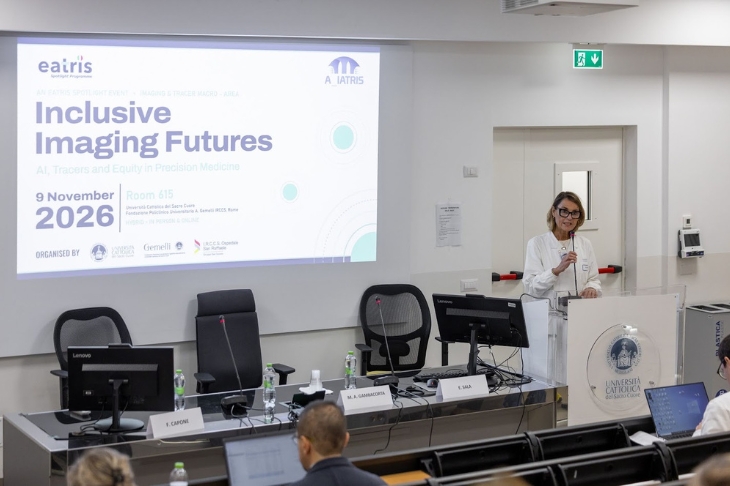
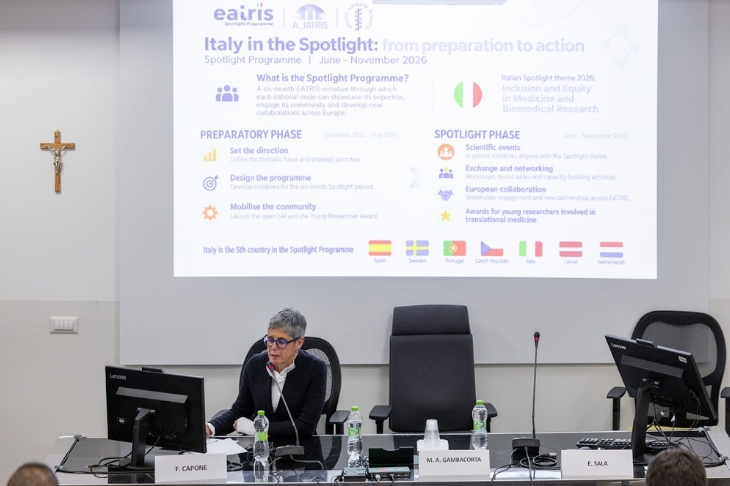
European Infrastructure for Translational Medicine (EATRIS) is the European research infrastructure dedicated to accelerating the translation of scientific discoveries into innovative solutions for patients and society. In 2024, EATRIS launched the Spotlight Programme, an initiative aimed at showcasing the scientific excellence, expertise and strategic priorities of its national ‘nodes’. Every six months, a national node selected by EATRIS is placed ‘in the spotlight’ and coordinates a series of events and activities dedicated to a topic of particular relevance to translational medicine. From June to November 2026, Italy was selected as the fifth country to lead the initiative, through the A_IATRIS network which, coordinated by Istituto Superiore di Sanità, brings together leading institutions, including IRCCSs, universities and research centres, fostering a strong and collaborative ecosystem in the field of translational medicine.
The Italian edition of the Spotlight Programme is dedicated to the topic “Inclusion and equity in medicine and biomedical research” and aims to promote a more inclusive, accessible and representative approach to biomedical and translational research, one that is capable of fully valuing biological, social and cultural diversity and responding more effectively to the needs of all populations.
Throughout the Spotlight period, the Programme fosters dialogue and collaboration between researchers, clinicians, policymakers, patient organisations and other stakeholders, encouraging interdisciplinary exchange and strengthening the wider EATRIS community. Through scientific events co-organised by several institutions within the A_IATRIS network, such as the one in Rome, the Programme addresses key issues including equitable access to biomedical technologies, diversity in clinical and pre-clinical research, the inclusion of vulnerable populations, as well as new challenges relating to ethics, regulation, artificial intelligence and precision medicine.