NEWS | Research

RECs: a study by six faculties at Università Cattolica. The findings and the need for further training

18 settembre 2026

RECs: a study by six faculties at Università Cattolica. The findings and the need for further training

Condividi su:

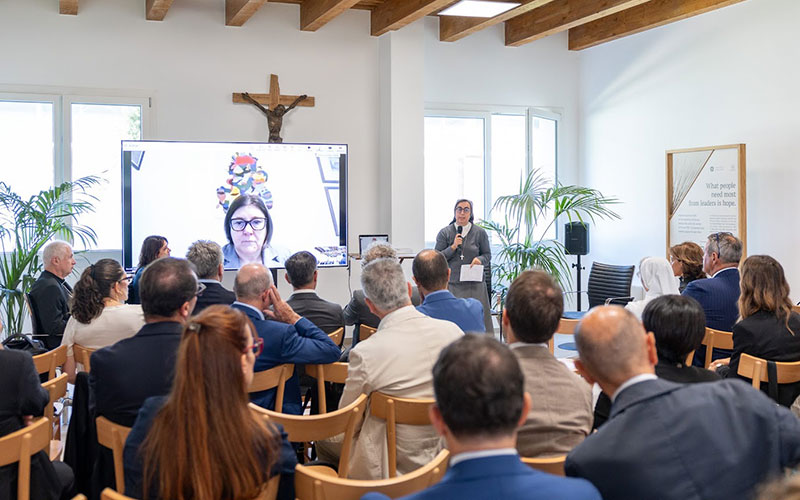
A comprehensive overview of the phenomenon of Renewable Energy Communities (RECs), thanks to the contribution of six faculties of Università Cattolica del Sacro Cuore, with a series of findings that can be put into practice in a rapidly expanding sector, straddling the promotion of renewable energy sources and benefits for communities. CER-CARE – Comunità Energetiche Rinnovabili tra Cura e Ricerca: Approcci e Strumenti per la Resilienza e l’Equità (Renewable Energy Communities between Care and Research: Approaches and Tools for Resilience and Equity) is the research topic, which forms part of a project of particular interest to the University (funding line D3.2 2022). The study was presented during the event held on Wednesday 16 September at the Borgo Laudato Si’ in Castel Gandolfo.

‘Presenting this project,’ said Elena Beccalli, Rector of Università Cattolica del Sacro Cuore, remotely connected from Milan, ‘is a concrete demonstration of our mission to be a research university, capable of fostering fruitful dialogue across generations and disciplines. It is within this framework that projects of particular interest to the University are positioned; supported by internal resources, they aim to investigate, from an interdisciplinary perspective, the major issues of our time, such as the impact of the climate crisis and the fight against inequality. It is precisely within this context that the CER-CARE project is situated, dedicated to analysing, over the last three years, the nature and impact of Renewable Energy Communities as tools of genuine social – as well as technological – innovation in response to energy inequalities.’

According to Sister Alessandra Smerilli, Prefect of the Dicastery for Promoting Integral Human Development, ‘integral ecology is not just about caring for the planet and nature: it is about caring for our relationships with others, with creation, but also with ourselves and with God. This is what “integral” means. It is important to combine research and professional expertise with a perspective that enables us to see the world as a web of relationships that we must build and nurture.’

For Professor Alessandra Vischi, head of the project on RECs, ‘one of the most significant aspects of these three years of research has been the interdisciplinary, inter-faculty and inter-campus collaboration, which has enabled different forms of knowledge, expertise and languages to engage in dialogue, in line with the values of a research university. The synergy between different faculties has represented added value for university research, which is increasingly based on the integration of knowledge, enabling us to tackle contemporary challenges in line with the core values and mission of our University.’

‘It is an honour for Università Cattolica del Sacro Cuore to engage with the Borgo Laudato si’ initiative, with which it shares aims and objectives, particularly through the work of the Graduate School for the Environment (ASA), established even before the publication of the Encyclical Letter Laudato si’,’ observed Monsignor Claudio Giuliodori, General Ecclesiastical Assistant of the University.

‘Borgo Laudato Si’ demonstrates that the energy transition is not merely a technological necessity, but an opportunity to rethink our relationship with the environment and with local communities. It is from this vision that the model of a real ‘positive energy district’ has been born, a model where engineering and innovation are placed at the service of communities, environmental protection and future generations,’ said Mr Antonino Errigo, engineer, Secretary-General of the Laudato si’ Higher Education Centre.

An article by

Editorial Staff

Editorial Staff

Condividi su:


The CER-CARE project was developed over three years, involving six different working groups organised around the faculties of Education; Mathematical, Physical and Natural Sciences; Political and Social Sciences; Agriculture, Food and Environmental Sciences; Economics and Law and the School of Banking, Finance and Insurance.

The research project highlighted that, despite having strong inclusive potential, RECs tend to develop primarily in contexts already endowed with economic resources, technical expertise, social capital and efficient administrations, whilst the most vulnerable areas – where the benefits would be most needed – face greater obstacles to the spread of RECs. According to researchers from the Faculty of Mathematical, Physical and Natural Sciences, what is therefore essential is not so much economic incentives as targeted public policies, support for local authorities and organisational models capable of engaging vulnerable citizens and households.

Equally necessary for the functioning of a REC, as explained by the Faculty of Education, are charismatic leadership, informed citizens, a sense of responsibility and the capacity for cooperation: from this perspective, education and training play a key role.

Among the outcomes of the project, the School of Banking, Finance and Insurance examined from a financial perspective how to structure the contract between RECs and Energy Service Companies (ESCo) to incentivise the operator’s commitment, share the risk and preserve the social objectives of the community. The aim is to identify contractual terms and policy measures designed to improve the financial sustainability of RECs without compromising their social function.

From a legal perspective, the research highlighted certain critical issues within the current framework that may affect the certainty of tax treatment and, consequently, the organisational decisions of operators. The study by the Faculty of Economics and Law also revealed how RECs must balance economic and social objectives, which may give rise to decision-making tensions. This led to the identification of a meta-requirement in their design to manage the trade-off between efficiency and inclusion, and the definition of principles for developing dashboards capable of supporting transparent decision-making through ad hoc simulations, data traceability and multidimensional impact indicators.

Furthermore, thanks to the contribution of the Faculty of Political and Social Sciences, the research enabled the development of guidelines – organised in an operational handbook – containing the most appropriate regulatory, organisational and procedural solutions for the various REC models and the different objectives pursued.

Finally, the research group from the Faculty of Agriculture, Food and Environmental Sciences created a solid ‘energy bridge’ between the REC promoted by Università Cattolica del Sacro Cuore and EDUCatt, and the eXnovo project run by the social cooperative L’Orto Botanico – a social farming initiative launched within the Piacenza Prison – with a mutual benefit: on the one hand, the REC would have had a further guarantee in relation to the consumption of the energy produced, whilst the eXnovo project would have been able to purchase the energy at a very favourable market price, thereby securing an additional element of economic sustainability that is not always easy to achieve in a social context. This experience provided an opportunity to demonstrate how a renewable energy community can take on a strong social dimension, as well as becoming a real instrument of solidarity.

Newsletter

Scegli che cosa ti interessa
e resta aggiornato

Iscriviti